
Full Digital Growth Audit
Find the Gaps Holding Back Your Website, Search, Paid Media, Social, and Conversions
Your marketing may not need a full rebuild. It may need a clearer diagnosis before you spend more.
The Full Digital Growth Audit is a full digital marketing audit of your website, UX, conversion paths, SEO, local search, PPC, paid and organic social, backlinks, analytics, tracking, competitor visibility, and AI search readiness. I do the audit myself, drawing on more than 20 years in SEO, paid search, and analytics.
You get one picture of the customer journey and a prioritized Fix First roadmap, not twelve disconnected channel reports:
- Visibility
- Trust
- Traffic
- Conversion
- Attribution
- Scale
Request a Full Digital Growth Audit See what's included · See a sample audit
Why This Audit Exists
Many companies are already investing in websites, SEO, content, paid search, social media, analytics, and marketing tools. The problem is that these pieces often operate in silos.
- Your SEO may be improving, but the landing pages may not convert.
- Your PPC campaigns may be generating traffic, but the tracking may not show which leads are actually valuable.
- Your local profiles may have reviews, but incomplete services, categories, or office-level signals may be limiting visibility.
- Your social content may look active, but may not be building enough trust or demand.
The Full Digital Growth Audit connects these pieces into one clear picture, so your team can decide what to fix first before increasing spend, redesigning a website, restructuring campaigns, or launching new growth initiatives.
What the Full Digital Growth Audit Answers
This audit is designed to answer the questions that matter most to business owners, CMOs, marketing directors, agency partners, and professional services firms.
- Are we visible in the right search results, local results, paid placements, and social channels?
- Are our most important pages built to rank, build trust, and convert?
- Are users reaching the right call to action quickly enough?
- Can leadership trust the analytics data being used to make budget decisions?
- Which fixes should happen first?
See the full question list
- Are technical SEO issues limiting our organic search performance?
- Are our local SEO and Google Business Profile signals strong enough to compete?
- Are our PPC campaigns structured efficiently, or are we missing high-intent opportunities?
- Are paid social and organic social helping us build demand, trust, and remarketing audiences?
- Are our forms, calls, and conversion actions being tracked correctly?
- Where are competitors outperforming us, and which gaps are realistic to close?
- Is our content clear and structured enough for modern search, AI summaries, and answer engines?
What Is Included in the Full Digital Growth Audit
This is not a generic SEO audit. It includes SEO, but it also reviews the broader digital ecosystem that determines whether your marketing can attract, persuade, convert, and measure the right audience: twelve areas across your website, search, paid media, social, analytics, and competitors.
1. Executive Growth Summary
What it reviews: The highest-impact findings, the clearest risks, the strongest opportunities, and the recommended order of action.
Business benefit: Leadership gets a concise, non-technical summary of what matters most. This helps teams avoid getting lost in long lists of disconnected issues.
2. Website, UX, and Message Clarity Review
What it reviews: Website structure, navigation, page layout, mobile usability, trust signals, calls to action, page flow, and clarity of messaging.
Business benefit: Your website should make it easy for visitors to understand who you help, why they should trust you, and what they should do next. This section identifies friction that may be weakening engagement or leads.
3. Conversion Rate Optimization Audit
What it reviews: Lead forms, phone calls, CTA placement, above-the-fold content, mobile conversion flow, landing page intent, sticky call options, urgency signals, and trust reinforcement near key actions.
Business benefit: A conversion rate optimization audit helps identify where high-intent visitors may be dropping off. Improving conversion paths can make every traffic source more valuable, including SEO, PPC, local search, and social.
4. Technical SEO Audit
What it reviews: Crawlability, indexability, metadata, headings, schema markup, image alt text, broken links, canonical tags, internal linking, sitemap quality, page speed concerns, duplicate content, and template-level SEO issues.
Business benefit: Technical SEO issues can quietly limit visibility. This section identifies problems that may prevent search engines from crawling, understanding, and ranking your most important pages.
5. On-Page SEO and Content Opportunity Review
What it reviews: Priority pages, keyword targeting, title tags, meta descriptions, H1s, content depth, topic coverage, internal links, content gaps, and evergreen content opportunities.
Business benefit: Many websites already have useful content, but it may not be aligned with the searches, questions, and page formats that matter most. This section identifies where content can be refined, expanded, consolidated, or repositioned for better search performance.
6. Local SEO and Google Business Profile Audit
What it reviews: Google Business Profile completeness, categories, services, hours, photos, posts, reviews, review freshness, citations, NAP consistency, location pages, and office-level local visibility.
Business benefit: Local SEO is often won or lost at the location level. This local SEO audit helps identify whether each office, location, or service area has the signals needed to compete in Google Maps, local packs, and local organic results.
7. PPC Audit and Paid Search Review
What it reviews: Campaign structure, keyword coverage, match types, search terms, negative keywords, ad copy, location targeting, bidding, budget allocation, conversion actions, and landing page alignment.
Business benefit: Paid search can scale quickly when the account structure, keywords, ads, tracking, and landing pages are aligned. This PPC audit identifies wasted spend, missed coverage, weak conversion paths, and expansion opportunities.
8. Paid Social and Organic Social Review
What it reviews: Channel consistency, content mix, audience fit, short-form video use, educational content, promotional balance, creative formats, trust assets, paid social opportunities, and remarketing potential.
Business benefit: Social should do more than prove your brand is active. It should build trust, educate prospects, support demand generation, and provide strong creative for paid amplification.
9. Backlink, PR, and Authority Review
What it reviews: Referring domains, backlink quality, anchor text, directory reliance, local authority links, industry links, competitor link gaps, PR opportunities, and digital authority signals.
Business benefit: Authority still matters, but not all links are equally useful. This section reviews whether your backlink profile supports real search growth, brand credibility, and local or industry relevance.
10. Analytics Audit, Tracking, and Attribution Review
What it reviews: GA4, Google Tag Manager, conversion events, form tracking, call tracking, paid media attribution, cross-domain tracking, consent considerations, reporting gaps, and dashboard readiness.
Business benefit: Incomplete tracking leads to incomplete budget decisions. This analytics audit helps determine whether your team can trust the data being used to measure leads, campaigns, channels, and marketing ROI.
11. Competitor Visibility and Market Review
What it reviews: Organic competitors, local competitors, paid search competitors, content competitors, review gaps, backlink gaps, messaging differences, and channel maturity.
Business benefit: This section shows where competitors are winning, why they may be winning, and which gaps are most realistic to close.
12. AI Search and Answer Engine Readiness
What it reviews: Content clarity, structured data, entity signals, author and expertise signals, FAQs, internal linking, citations, topical authority, and answer-friendly page structure.
Business benefit: AI answer engines now summarize and recommend businesses directly, and they recommend far fewer businesses than traditional search shows. This section reviews whether your content is clear, credible, structured, and easy for both search engines and AI-powered answer systems to understand, summarize, and reference. For the bigger picture, see AI for Small Business: How to Implement It in 90 Days.
If three or more of those areas have not been reviewed together, that is usually the gap.
The expensive move is adding spend, a redesign, or a campaign restructure before the leaks are named.
Request a Full Digital Growth AuditHow It Works
- Kickoff call or questionnaire. You share your goals, priority services or locations, known competitors, and any constraints. Your choice of a short call or a written questionnaire.
- I build the audit. Over 2 to 3 weeks, I review all twelve areas using external data and connect the findings into one prioritized roadmap. No logins are required, though optional read-only access lets me go deeper (see below).
- Presentation meeting. When the audit is ready, we meet so I can walk you through the findings, the Fix First list, and the recommended order of action.
- Optional: implementation. The audit is a standalone deliverable. If you want help putting the recommendations to work, I can be contracted separately once the audit is complete.
Why it costs less and moves faster than an agency audit: this is the same full-funnel audit top-tier agencies sell for $10,000 or more, done by someone who still does this work at that level. You pay for the analysis, not the overhead. It takes 2 to 3 weeks instead of 2 to 3 months, because there are no account teams, handoffs, or committees between you and the person doing the work.
How Recommendations Are Prioritized
A strong digital marketing audit should not leave your team with a giant list of tasks and no clear order of action. The Full Digital Growth Audit organizes recommendations by likely impact, urgency, effort, and business value.
| Priority Category | What It Means |
|---|---|
| Fix First | High-impact issues that may be limiting leads, rankings, tracking, user experience, or media efficiency. |
| Quick Win | Lower-effort improvements that can create practical near-term gains. |
| Build Next | Strategic improvements that require planning, content development, campaign restructuring, or stakeholder input. |
| Monitor | Issues worth watching, but not urgent enough to distract from higher-value work. |
This prioritization helps your team focus on the actions most likely to improve visibility, trust, conversions, and marketing accountability.
Who This Audit Is For
The Full Digital Growth Audit is best for organizations that already have some marketing activity in place, but need an experienced, objective review before making bigger decisions.
Good Fit For
- Business owners who want clarity before investing more in marketing
- CMOs and marketing directors who need an objective review of channel performance
- Agency partners who need senior SEO, PPC, CRO, analytics, or digital strategy support
- Professional services firms competing in search, local, paid, and reputation-driven channels
- Multi-location businesses with office-level local SEO and conversion challenges
- B2B companies with complex buyer journeys and unclear attribution
- Healthcare, legal, financial, home services, education, and regional service brands
- Companies preparing for a website redesign, migration, or campaign expansion
- Teams that suspect their analytics, conversion tracking, or reporting setup may be incomplete
Example finding and a common pattern
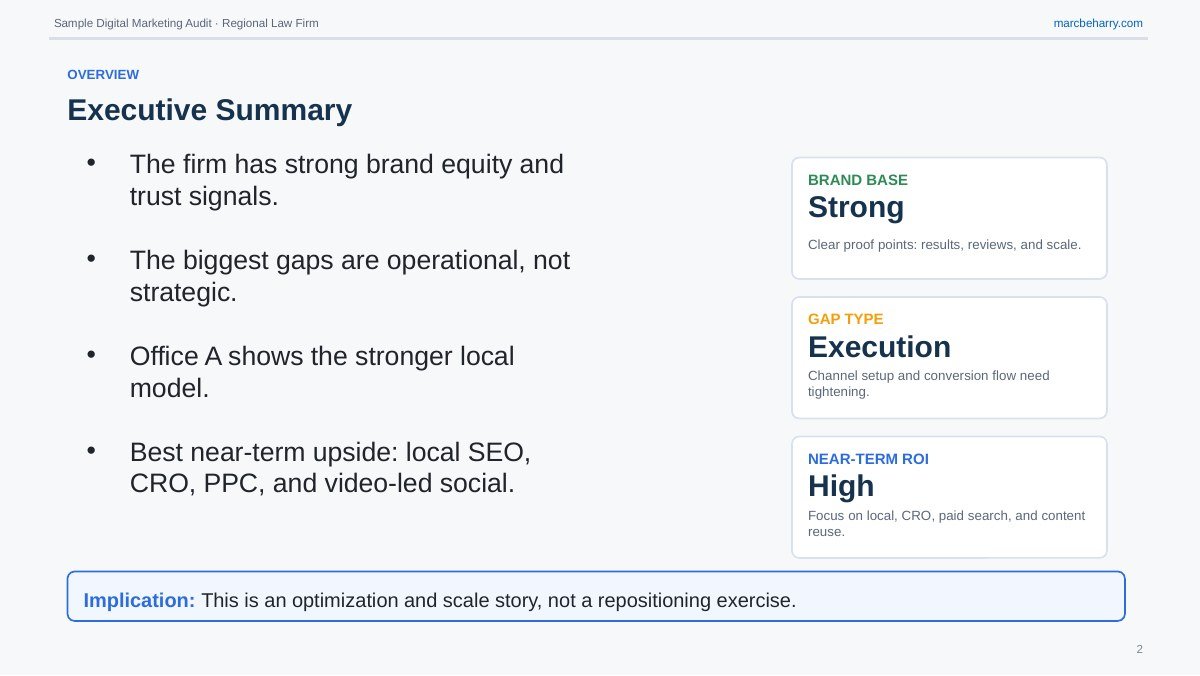
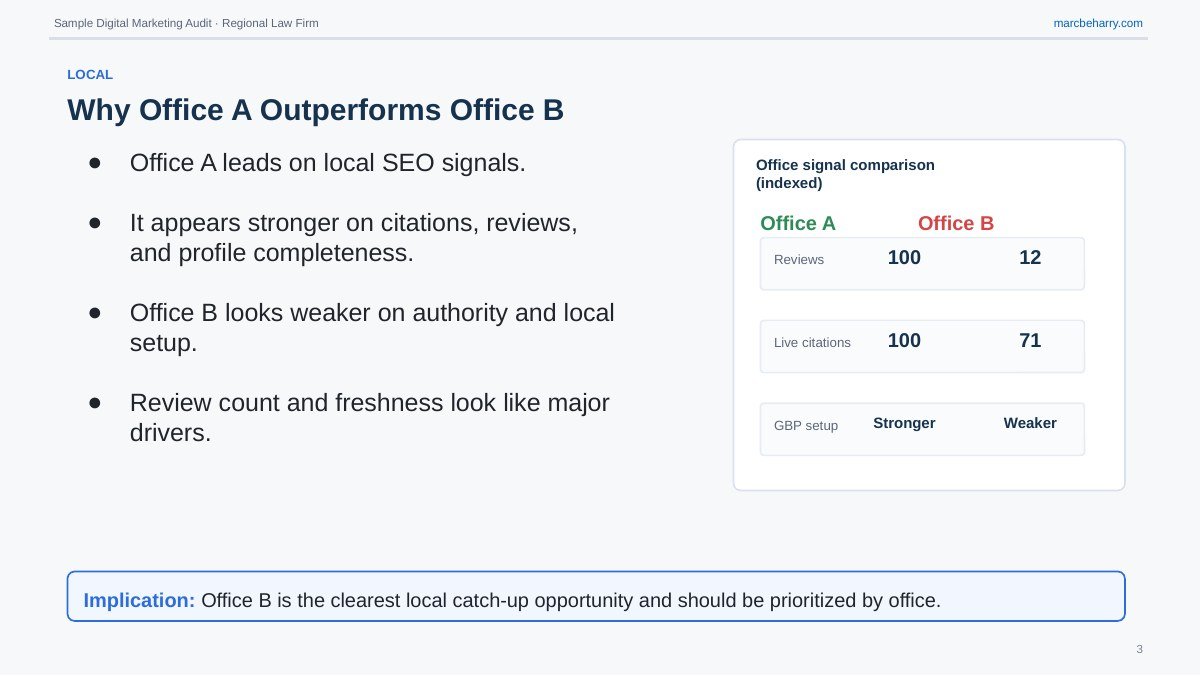
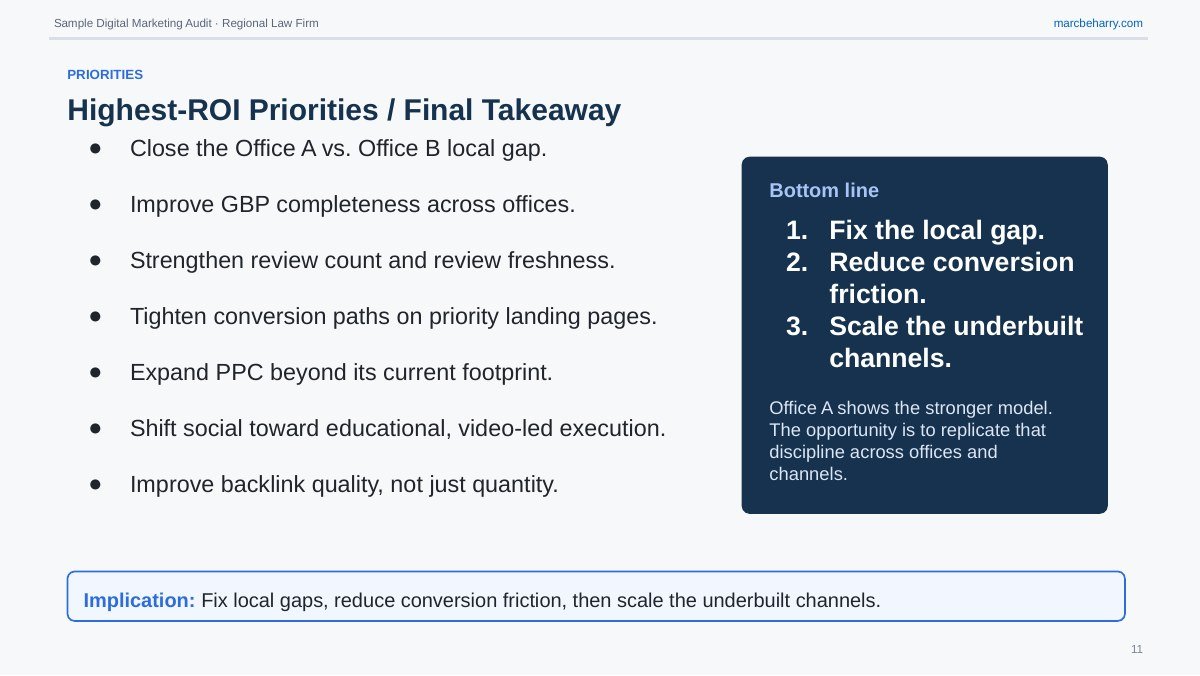
Example finding: In one anonymized audit for a multi-location law firm, the stronger office had about 8x the Google review volume of the weaker one, plus more live citations and a more complete Google Business Profile. The brand and trust signals were already strong, so the answer was not a rebuild. It was to fix the local gap first, then reduce conversion friction and scale underbuilt channels like PPC. See the slides.
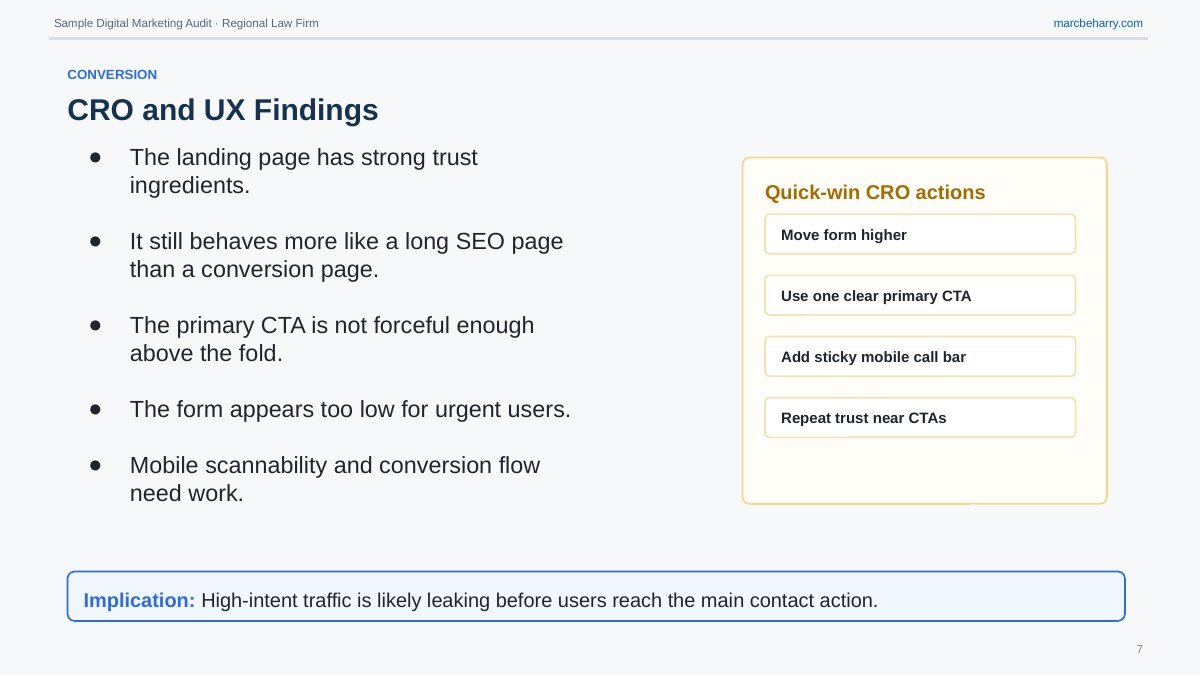
A common pattern: a company has good traffic but weak conversion paths. The issue is not always visibility. Users may not be reaching the right CTA quickly enough, the form may sit too low on mobile, or analytics may not show which actions are truly valuable.
What Clients Receive
Deliverables can be adjusted based on the size of the business, the number of locations, and the number of marketing channels.
Core Deliverables
- Executive summary of the highest-impact findings
- Full digital marketing audit report or presentation deck
- Channel-by-channel findings and recommendations
- Prioritized action roadmap
- An "Implication" for every finding: what it means for your budget and what to fix first
- A presentation meeting to walk through the findings
Full deliverable list
- Technical SEO audit summary
- On-page SEO and content recommendations
- Local SEO and Google Business Profile findings, when applicable
- PPC audit findings and paid search recommendations, when applicable
- Paid social and organic social observations
- Conversion rate optimization recommendations
- Analytics audit and tracking validation notes
- Competitor visibility observations
- AI search readiness recommendations
What I Need From You
No logins or platform access are required. The audit runs on external data, and the kickoff call or questionnaire covers the rest:
- Your website URL
- Priority products, services, locations, or audiences
- Known competitors
- Current goals, KPIs, and business constraints
Optional, but helpful: read-only access lets me go deeper on tracking, search performance, and paid media. Nothing is changed in your accounts.
- Google Analytics 4
- Google Tag Manager
- Google Search Console
- Google Ads or Microsoft Ads, if applicable
- Google Business Profile, if applicable
Access is what lets the audit move from visibility to business impact, with questions like these:
- Which channels drive qualified calls, form fills, and closed deals?
- Which landing pages attract traffic but underconvert?
- Where is attribution weakest across organic, local, paid, and social?
See a Sample Audit
Here are four slides from a real digital marketing audit I completed for a multi-location law firm, anonymized, with values indexed to protect the client. The full deck runs 12 slides: an executive summary, findings by channel, each ending with an implication, and a prioritized bottom line.
See all 12 findings slides, from executive summary to bottom line.
Download the Sample Audit (PDF)Optional Add-Ons
Some clients only need the audit. Others need help turning the findings into implementation. The audit itself does not include implementation, but optional add-ons and implementation support can be scoped separately once the audit is complete.
View optional add-ons
- Leadership presentation: A walkthrough of the audit findings for executives, stakeholders, or agency teams.
- 30/60/90-day implementation roadmap: A prioritized plan that organizes recommendations into near-term and longer-term workstreams.
- Keyword and page mapping: A practical map connecting target keywords to priority pages, new content opportunities, and internal linking needs.
- GA4 and GTM tracking plan: A clear tracking roadmap for forms, calls, lead events, paid media conversions, and reporting improvements.
- Local SEO cleanup plan: Office-level recommendations for Google Business Profile, categories, services, citations, reviews, and local landing pages.
- PPC restructure plan: Campaign, keyword, ad copy, landing page, and conversion recommendations for paid search improvement.
- Social content framework: A content mix and creative direction for educational, trust-building, promotional, and short-form video content.
- Backlink and digital PR plan: Authority-building opportunities focused on quality, relevance, local trust, and industry credibility.
- Implementation support: Ongoing consulting to help your internal team, developer, or agency partner execute the recommendations.
Who Does the Audit

Marc Beharry is a digital marketing and analytics strategist with more than 20 years of experience in SEO, paid search, and web analytics. He has worked with agencies and consultancies including Saatchi & Saatchi Wellness, Omnicom, Accenture, and ConsenSys.
Every Full Digital Growth Audit is done by Marc personally. There is no junior team and no handoff between the person who sells the audit and the person who does it.
Full Digital Growth Audit FAQ
How much does the audit cost?
- $2,500, flat.
- A comparable audit at a top-tier ad agency typically starts at $10,000. You get the same depth without the agency overhead.
How long does it take?
- 2 to 3 weeks from kickoff to the presentation meeting.
- Large agencies often take 2 to 3 months for a comparable audit.
Do you need logins or access to my accounts?
- No. The audit runs on external data and does not require platform access.
- Optional read-only access to GA4, Google Tag Manager, Search Console, or your ad accounts lets me go deeper on tracking and paid media.
- Kickoff is a short call or a questionnaire, whichever you prefer.
Can I see an example audit?
- Yes. Four anonymized slides from a real audit are shown above.
- The full anonymized deck is a free PDF download. See See a Sample Audit.
Is this just an SEO audit?
- No. SEO is one part of it.
- The audit covers twelve areas across your website, UX, conversion paths, technical and on-page SEO, local search, PPC, paid and organic social, backlinks, analytics and tracking, competitors, and AI search readiness.
- The findings are connected into one prioritized roadmap.
Do you implement the fixes?
- The audit does not include implementation.
- Once the audit is complete, I can be contracted separately to help put the recommendations to work, or your team or agency can run with the roadmap.
How is my data handled?
- Data privacy is a priority.
- I do not share your data with any third parties.
What do I get at the end?
- An executive summary, a full audit report or presentation deck, channel-by-channel findings, and a prioritized Fix First roadmap.
- A presentation meeting to walk through it all.
Ready to Find the Gaps Holding Back Your Digital Growth?
If your company is investing in search, paid media, social, content, analytics, or a website redesign, audit first. The Full Digital Growth Audit names what is working, what is leaking, and what should be fixed before you spend more.
$2,500 (typically $10,000+ at top-tier agencies). 2 to 3 weeks. No logins required. You leave with a prioritized roadmap focused on visibility, trust, conversions, attribution, and scale, including whether your content is structured for AI-powered answer systems as well as traditional search.
Request a Full Digital Growth Audit