

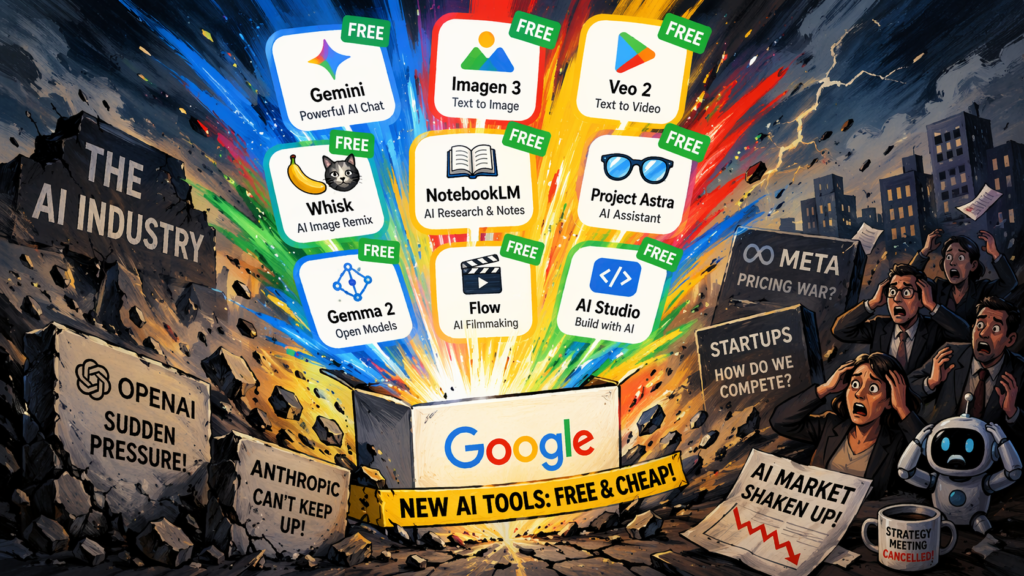
As of April 2026, Google has released a coordinated wave of free and open-source AI tools that are fundamentally shifting competitive economics in the AI industry. Veo 3.1’s free video generation, Gemma 4’s frontier-level open-source models, Opal’s no-code AI mini-app builder, and Gemini Enterprise’s aggressive pricing all signal a strategic play that smaller AI companies cannot easily counter. This consolidation mirrors patterns seen during previous tech platform shifts, and the window for independent AI startups is closing faster than many realize.
The Weapons: Google’s Free AI Arsenal
1. Veo 3.1: The Video Generation Equalizer
What Changed (April 2026): Google made Veo 3.1 free (with limits) across two channels: Google Vids and Google Flow. Users with a standard Google account can now generate up to 10 high-quality video clips monthly through Vids, or leverage ~50 daily AI credits in Flow.
The Disruption: Video generation startups like Runway, Pika Labs, and Synthesia built entire companies on the premise that access to generative video would be premium or scarce. Runway’s core value proposition, democratized video creation, is now delivered by the world’s most powerful technology company, distributed through Google’s ubiquitous ecosystem (Drive, Docs, Sheets, Slides).
The 720p resolution cap and “Made with Veo” watermark on free versions create a freemium tiering strategy that’s virtually impossible for independent competitors to match. Once users are in the Google ecosystem (which they already are), upgrading from free to paid becomes a low-friction decision.
Market Impact:
- Runway’s enterprise positioning becomes harder to defend when the base technology is free
- Smaller video generation startups face an existential question: can they differentiate fast enough?
- Integration into Google’s workspace means videos and AI generation become a unified workflow, not a separate purchase
2. Gemma 4: The Open-Source Capability Shock
What Changed (April 2, 2026): Google released Gemma 4 under Apache 2.0 license, truly open, no attribution required. The 26B MoE and 31B dense models deliver “frontier-level capabilities” with significantly lower hardware overhead. Models run on single consumer GPUs and scale to 256K token contexts.
The Disruption: This hits the entire mid-market LLM ecosystem. Companies like Mistral, Stability AI, and others built defensibility around proprietary model quality. Gemma 4’s performance claims, competing with much larger proprietary models, obliterate the “open source = good enough” narrative. Open source now means frontier performance, not compromise.
The Apache 2.0 license means enterprises can:
- Deploy locally without API dependencies
- Fine-tune for proprietary tasks
- Build products on top with zero licensing friction
- Avoid vendor lock-in entirely
Market Impact:
- LLM API providers (especially mid-tier players) lose pricing power
- Open-source model companies face margin compression or commoditization
- Enterprises shift from API subscriptions to self-hosted deployments
- Differentiation must now come from fine-tuning expertise, domain knowledge, or application layer, not base models
3. Opal: The No-Code AI App Platform Play
What Changed (Recently Upgraded February 2026): Google Labs’ Opal shifted from a visual workflow builder to a genuine agent platform. Non-technical users can now describe a task in plain language, and Opal’s agent autonomously plans steps, selects tools (Google Sheets, web search, Veo for video), and executes workflows. It’s free, hosted, and shareable via simple links.
The Disruption: Opal directly competes with:
- Low-code/no-code AI platform startups (Zapier, Make, n8n competitors in the AI layer)
- Specialized vertical AI SaaS tools (customer support bots, content workflows, data entry helpers)
- Consulting firms selling “AI automation” to SMBs
The magic here: Opal has native integrations with Google services (Sheets, Drive, Gmail, Search, Veo) out of the box. Building a competing workflow platform that’s as integrated and free is nearly impossible.
Market Impact:
- Startups selling “no-code AI agents” lose their primary distribution channel
- Vertical SaaS tools must now compete with free, general-purpose alternatives
- Enterprises can rapidly prototype internal tools without vendor contracts
- SMBs who were early Zapier/Make customers can now get AI-first workflows for free
4. Gemini Enterprise: The Premium Play (With Strategic Freemium Hooks)
What Changed: Google launched Gemini Enterprise editions (Standard, Plus, Frontline) with a 30-day free trial. Consumer tiers remain aggressive: $19.99/month for Pro, $124.99/quarter for Ultra.
The Disruption: Unlike point solutions, Gemini Enterprise targets the entire enterprise AI infrastructure market. It competes with:
- Anthropic’s Claude (limited free tier, higher API costs)
- OpenAI’s enterprise offerings
- Specialized enterprise AI platforms
The 30-day free trial isn’t altruism, it’s a foot-in-the-door strategy for CIOs evaluating AI platforms. Once Gemini becomes the default in Google Workspace (which it is, for millions), switching costs for enterprises become prohibitive.
Market Impact:
- Enterprise AI startups lose deal velocity during the free trial period
- Integration with Google Workspace becomes a hard-to-beat advantage
- Smaller AI companies relying on OpenAI/Anthropic APIs face pressure from customers demanding “Google’s AI” as an option
The Strategic Play: Why This Is Coordinated Warfare
Google isn’t releasing these tools accidentally or incrementally. The April 2026 launches signal a deliberate strategy:
- Horizontal Coverage: Video (Veo), LLMs (Gemma), No-Code (Opal), Enterprise (Gemini), Google is attacking multiple TAMs simultaneously
- Distribution Advantage: All tools integrate with Google’s 2B+ user ecosystem (Workspace, Gmail, Drive, Search)
- Freemium Trap: Free tier creates habit formation; paid tier creates switching costs
- Open + Closed: Gemma 4 (open-source, run-your-own) + Gemini Enterprise (managed, proprietary) cover all customer segments
- Deflationary Pricing: Even when paid, Gemini pricing undercuts competitors
The Casualties: Which AI Startups Are Most at Risk?
Critical Risk (Next 12-24 months)
Video Generation Startups:
- Runway, Pika Labs, and other video-first founders face immediate pressure
- Unless they own a specialized vertical or enterprise relationships, the narrative breaks down
- Runway’s pivot to AI editing suite provides some shelter, but the narrative is now “alternative to Veo,” not “the video AI platform”
No-Code / Low-Code Workflow Platforms:
- Zapier and Make have moats (ecosystem lock-in, 1000s of integrations), but new entrants in AI-first automation are dead on arrival
- Specialized AI workflow startups (content creation, customer support, data operations) are in direct competition with a free Google product
Mid-Market LLM Companies:
- Mistral, Stability AI, and other open-source model providers face compression in the “good enough” market segment
- Their defense must be rapid innovation, vertical specialization, or enterprise relationships, not base model quality
Enterprise AI Startups Without a Moat:
- If your value prop is “we make AI accessible,” you’re now competing with Gemini Enterprise’s free trial and integration with Workspace
- Survival requires defensible differentiation: domain expertise, proprietary data, or vertical SaaS characteristics
Moderate Risk (Next 24-36 months)
Specialized Vertical AI Tools:
- Customer support (Conversica, Intercom’s AI, Zendesk’s AI)
- Content generation (Copy.ai, Jasper, Writesonic)
- Sales enablement (Salesloft’s AI, Outreach’s AI)
- Unless these tools have deep industry knowledge or exclusive data, they’ll feel commoditized pressure
Fine-Tuning / Model Customization Startups:
- Companies offering Mistral or Llama fine-tuning services will see demand shift to Gemma 4 fine-tuning or in-house Gemini Enterprise models
- Long-term survival requires deep vertical expertise or proprietary training data
Lower Risk (For Now)
Companies with Proprietary Data Advantages:
- Startups in healthcare AI, financial services, or supply chain with exclusive datasets retain competitive advantage
- Google’s data advantage in generic tasks doesn’t translate to domain-specific excellence
Embedded / Hardware AI:
- On-device AI, edge inference, and specialized hardware remain differentiated
- Gemma 4’s on-device focus actually provides a tailwind for hardware-focused startups
Research-Stage Frontier AI:
- Companies pushing novel architectures, multimodal breakthroughs, or reasoning improvements still have intellectual property value
- But turning research into defensible products is exponentially harder now
The Structural Problem: Why Small Teams Can’t Compete
Cost of Staying Competitive
Building Veo 3.1-quality video generation requires:
- $100M+ in training compute
- World-class team (which Google can hire or acquire)
- Proprietary datasets (which Google owns)
- Years of R&D
A startup with $10-50M in funding cannot match this. The capital requirements to build frontier models have increased 10x in 5 years. Smaller teams can innovate around frontier models, but not replace them.
Distribution Moat
Google’s distribution advantage is nearly unbeatable:
- 2B+ Gmail users can access Gemini in their inbox
- 1M+ Google Workspace organizations default to Gemini for their AI layer
- Google Workspace integrations (Sheets, Docs, Drive, Meet) create a gravitational pull toward Gemini
- Chrome browser can distribute tools at zero marginal cost
A startup’s GTM motion (sales team, marketing, partnerships) is inherently more expensive and slower than Google flipping a feature flag to 2B users.
The Free Tier Problem
Venture-backed startups require pricing power to achieve VC returns (typically $10M+ ARR). If the feature set available at a $0 price point captures 80% of the use case, the addressable market for paid features shrinks.
Example:
- Veo 3.1 free: 10 videos/month, 720p, watermarked
- Runway Pro: “unlimited” videos, 4K, no watermark, more controls
- For most SMBs and content creators, Veo free is “good enough”
- Runway’s payable segment shrinks to professionals and enterprises, a smaller TAM
The Market Consolidation Narrative
What Happened in Mobile (2007-2012)
When iOS and Android launched, thousands of mobile app companies became acquihires. The platform owner (Apple, Google) captured 70% of the value. Indie developers built features on top, but didn’t build billion-dollar companies.
What’s Happening in AI (2024-2026)
The parallel is stark:
- Gemini/Claude/GPT-4 = the OS layer (frontier model accessibility)
- Opal/Zapier/vertical SaaS = the app layer (features and UX on top)
- Indie model companies = the “mobile app developer” layer (increasingly squeezed)
The winner’s circle for AI startups is shrinking to:
- Application-layer companies with strong UX, domain expertise, or enterprise relationships
- Infrastructure companies (vector DBs, prompting frameworks, fine-tuning services)
- Specialized agents for narrow, high-value tasks (e.g., AI for FDA drug approval, legal discovery)
General-purpose model companies and feature-parity SaaS tools are increasingly non-viable.
Specific Threat Assessment by Business Model
Subscription SaaS on Top of APIs
Threat Level: CRITICAL
Example: A startup charging $50/month for “AI customer support.”
- Opal now allows SMBs to build this for free using Gemini + Sheets integrations
- No enterprise advantage, no proprietary data, no switching cost
- Survival requires vertical specialization or enterprise relationships
Defense:
- Shift upmarket to enterprises; commoditize the SMB segment
- Add domain-specific knowledge (e.g., “AI support for SaaS,” not “AI support for everyone”)
- Build data moats (customer conversations become training data for better models)
Fine-Tuning / Model Customization
Threat Level: HIGH
Example: A startup offering Mistral fine-tuning services.
- Gemma 4 now allows customers to fine-tune on-device
- No API dependency, lower cost
- Enterprise customer who was paying for outsourced fine-tuning now does it in-house
Defense:
- Provide domain-specific training data or frameworks
- Build enterprise contracts with switching costs (managed fine-tuning services, ongoing optimization)
- Position as an alternative to in-house ML teams, not a boutique service
Vertical AI SaaS with Generic Models
Threat Level: HIGH
Example: An AI tool for real estate agents (property descriptions, open house scripts).
- Opal’s agent can be configured to do this in 15 minutes
- Zapier has integrations with Zillow, MLS, and email, now with AI agents
- The startup’s differentiation was “easy AI,” but Opal is easier and free
Defense:
- Add domain expertise (training on 10,000 successful real estate campaigns)
- Build integrations that Opal/Zapier can’t easily replicate
- Create a community or network effect (agents sharing prompts, templates, best practices)
Open-Source Model Companies
Threat Level: CRITICAL
Example: Mistral, Stability AI
- Gemma 4 is open-source, frontier-quality, runs on-device
- Performance advantage is gone
- Enterprise switching cost is zero (same open license, different model weights)
Defense:
- Double down on model innovation (stay ahead of Gemma on benchmark performance)
- Build specialized models (domain-specific, fast inference, specific task optimization)
- Create a managed platform (model serving, fine-tuning, monitoring)
- Partner with enterprises to become the “preferred open model”
Responses: Playbooks for AI Startups Under Pressure
1. Pivot to Vertical SaaS
Move from horizontal (“AI for everyone”) to vertical (“AI for ___”).
Play:
- Choose a vertical where you have domain expertise or existing customer relationships
- Build proprietary training data or workflows specific to that industry
- Create switching costs through integrations, compliance certifications, or industry partnerships
- Price based on industry metrics (e.g., per-agent for customer support, per-campaign for marketing)
Examples that might work:
- AI for legal discovery (legal domain, high compliance needs)
- AI for FDA drug approval workflows (scientific domain, regulated)
- AI for manufacturing quality control (hardware + AI moat)
2. Become Infrastructure, Not Application
Stop building features on top of models. Start building the layer underneath.
Plays:
- Vector databases and retrieval-augmented generation (Pinecone, Weaviate)
- Fine-tuning and model serving infrastructure
- Synthetic data generation for training
- Prompt optimization and routing engines
- LLMOps / observability for enterprise AI deployments
Why this works:
- Infrastructure vendors have smaller addressable markets but much higher margins
- Google is weak in specialized infrastructure (they use open-source tools like TensorFlow, not proprietary alternatives)
- Enterprise AI requires orchestration, not just model access
3. Build a Specialized Agent or Workflow
Instead of a general platform, build the best agent for one specific task.
Play:
- Focus on a task that’s valuable enough to justify paid tiers but narrow enough to differentiate
- Example: “AI for managing AWS billing” (narrow task, enterprise value, technical integration complexity)
- Example: “AI for generating legal contracts from email threads” (narrow task, compliance sensitive, specific domain)
Criteria for success:
- Task has >$100K annual value to enterprise customers
- Requires specialized knowledge or integrations
- Meaningful differentiation vs. generic Opal workflows
- Clear path to enterprise contracts with switching costs
4. Acquire or Partner with Enterprises
The startup-to-enterprise pathway has compressed.
Play:
- Target enterprises that are now evaluating Gemini Enterprise
- Offer “Gemini Enterprise plus [your specialized layer]”
- Partner with Google to be a reseller or integration partner
- Build switching costs through customization, workflows, training
Why this works:
- Enterprises already trust Google; your job is to make Gemini work for their specific use case
- You become the implementation/integration partner, not the core technology provider
- Recurring revenue comes from services, not software
5. Go Deeper on Frontier Research
If you can’t compete on deployment, compete on discovery.
Play:
- Stay at the research frontier: novel architectures, reasoning breakthroughs, multimodal advances
- Build intellectual property that larger companies need
- Become an acquihire target, IP acquisition, or research partner
Reality check:
- This requires $50M+ in funding and elite talent
- Exit is likely acquisition, not IPO
- Timeline is 5-10 years, not 2-3
The Longer View: Where Opportunities Remain
1. Enterprise Customization and Compliance
Enterprises have unique requirements: data residency, compliance certifications, custom integrations, audit trails. Building the layer that sits on top of Google/OpenAI/Anthropic models and handles enterprise concerns is a viable business.
2. Industry-Specific AI
Vertical SaaS is harder to build but has higher moats. Companies in healthcare, finance, law, manufacturing with domain expertise + AI can create defensible positions.
3. AI + Hardware Integration
On-device AI, robotics, autonomous systems, edge inference, these have hardware moats that software-only companies can’t easily replicate. Gemma 4’s on-device optimization is actually a tailwind here.
4. The Application Layer
If Google controls the model layer (Gemini) and orchestration layer (Opal), the application layer becomes a commodity, but it still gets built. Companies that build specialized interfaces, UX, or workflows for specific user segments can survive.
Example: Figma didn’t build the graphics engine; they built the interface that made it usable. AI applications will increasingly be about UX, distribution, and user lock-in, not model quality.
5. New Frontiers
- Reasoning and agentic AI (systems that plan, not just generate)
- Multimodal models with specialized senses (audio, video, sensor data)
- Personalization at scale (models that improve with user data)
- Privacy-preserving AI (federated learning, differential privacy)
These frontiers are less crowded and not yet dominated by Google. Early movers can establish positions.
Scenario Planning: Three Possible Futures
Scenario 1: Google Wins Decisively (Most Likely, 70% probability)
- By 2027, Gemini is the de facto AI layer for 80% of enterprises
- Opal captures 50%+ of the no-code automation market
- Veo 3+ is the standard for video generation
- Gemma 4 is the default open-source model for SMBs and on-device deployments
- Most specialized AI startups either pivot to vertical SaaS, become infrastructure, or get acquihired
For startups: Focus on integration with Google products, not replacement. Become a service layer, not a technology layer.
Scenario 2: Fragmented AI Ecosystem (25% probability)
- Claude and GPT-4 maintain significant market share due to brand loyalty and specialized strengths
- Open-source community fragments Gemma 4’s adoption (some prefer Mistral, Llama, others)
- Vertical SaaS flourishes because enterprises want specialized tools, not general platforms
- Opal doesn’t cannibalize all no-code competitors
For startups: There’s breathing room for specialists and alternatives. Differentiation on quality, speed, cost, or specialization can win.
Scenario 3: Regulatory Intervention (15% probability)
- Antitrust action forces Google to divest or restrict API access
- EU regulations require model interoperability
- Specialized AI tools get legal protection from “digital gatekeeping” laws
For startups: Longer runway, but dependent on political/regulatory shifts outside your control.
Conclusion: The New Reality
Google’s free AI tools represent a fundamental shift in competitive dynamics. The era of standalone AI startups building point solutions on top of models is ending. The era of specialized AI companies, those that combine models with domain expertise, industry relationships, or infrastructure innovations, is beginning.
For founders and investors, the question isn’t “Can we compete with Google?” It’s “Can we create more value in a world where frontier models are free?”
The answer is yes, but only if you:
- Pick the right segment: Vertical SaaS, infrastructure, specialized agents, enterprise customization
- Build defensible advantages: Domain expertise, proprietary data, integrations, switching costs
- Price based on value created, not commodity features
- Move fast: The window for establishing positions is closing
The startups that will win are those that understood in 2026 that the game had changed. For the rest, the window for pivots is measured in months, not years.






Comments are closed